
Method & Science
How Long Does
It Take to Get an American Accent?
The answer depends less on time and more on where you're starting from. A senior accent coach breaks down the four starting points and what each one really takes.

 CategoryMethod & Science
 Reading time3 min
 Published Date
 CoachCollins William
Coach, how long will it take me to get an American accent?
I get asked this every week. Sometimes every day.
And the honest answer is: it depends. Not in the frustrating “consultants love to say it depends” way. In the specific way that will save you months of wasted effort if you understand it.
Two people can start accent training on the same day, put in the same hours, follow the same method — and end up in wildly different places at the 90-day mark.
Not because one worked harder. Because they started from different places on the map
Why timelines vary so much
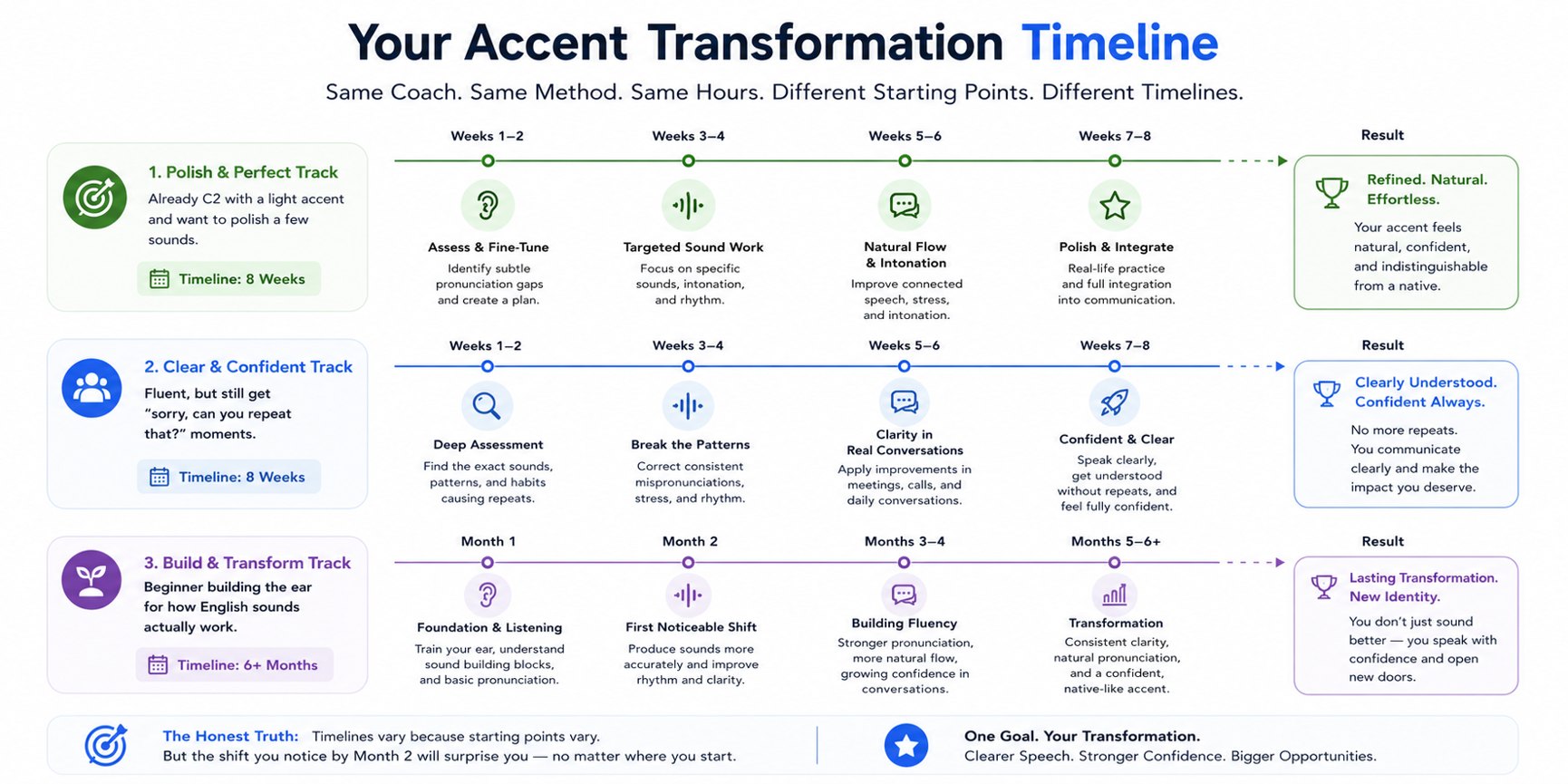
If you’re already at C2 English with a light accent and just want to polish a few sounds — 8 weeks is realistic.
If you’ve been in the US for 10 years, sound fluent, but every meeting still has that one “sorry, can you repeat that?” moment — 2 months of focused work can shift that permanently.
If you’re a beginner still building the ear for how English sounds actually work — the honest answer is longer. But the shift you notice by month 2 will surprise you.
Same coach. Same method. Same hours. Different starting points. Different timelines.
That’s the whole game.
“How long?” is the wrong question to start with. The right one is “where am I starting from?”
The four starting points
After 10+ years and 6,700+ students, almost everyone fits into one of four buckets.
01
The Advanced Speaker
You already sound about 85% American. You want to polish specific patterns.
~8 weeks of focused work.
02
The Fluent Non-Native
You speak great English. You have a clear accent. You get asked to repeat sometimes.
~2 months for a noticeable shift.
03
The Executive
You have a specific event — interview, keynote, board meeting — and need to be ready for it.
6-8 weeks of situation-specific coaching.
04
The Beginner
Still building the ear. Some English sounds still feel similar to each other.
Longer path — but the first 2 months move fast with the right coaching.
Pick the one that fits. That’s your bucket. Your timeline follows from there.
The YouTube trap
Here’s the thing that adds months (sometimes years) to people’s timelines.
Most accent advice on YouTube uses one method: “Listen to me say this word. Now repeat after me.”
And it doesn’t work for accent training. Not because the creators are bad — most of them are native speakers with good intentions. But because of how your brain actually processes sound.
When you hear a word, your brain filters it through the language you grew up with. If a distinction doesn’t exist in your first language, your brain literally can’t hear it at first. Japanese speakers struggle to hear the difference between R and L. Spanish speakers hear “ship” and “sheep” as the same word. Hindi speakers merge V and W.
So you listen. You think you’re copying what you heard. You reproduce something slightly different. And you can’t tell.
The more you repeat while your ear is still off, the deeper you groove in the wrong pattern. You’re not fixing your accent. You’re strengthening the exact thing you’re trying to change
That’s why some people watch 200 pronunciation videos and their accent barely moves. Not because YouTube is useless. Because “repeat after me” is the wrong first exercise.
What actually determines your speed
Four things
- Perception before production. Train your ear to hear the difference before you try to say it. Otherwise you’re guessing.
- Rhythm before individual sounds. Word stress and sentence rhythm affect clarity more than any single sound does. Most programs have this backwards.
- Your native language matters. Spanish, Hindi, Mandarin, and Japanese speakers all have different challenges. Generic advice can only take you so far.
- Feedback beats solo practice. You can’t fix what you can’t hear. Someone with trained ears catching your patterns is worth more than 100 hours of self-study.
Get those four right and you can move fast. Skip them and no amount of time gets you there.
A quick self-check
Read each line and see which one fits
“I sound almost American. I want to fix a few specific things.” → Advanced. 8 weeks.
“I watch English shows without subtitles, but people still ask me to repeat.” → Fluent Non-Native. 2 months.
“I have a big event coming up and need to be ready.” → Executive. 6-8 weeks.
“I’m still working on hearing the difference between similar English sounds.” → Beginner. Longer path — but you’ll surprise yourself by month 2.
That’s your starting point. That’s your timeline.
Ready to find out how
fast you can move?
Explore the Program




Latest Related

 Youtube
 TikTok
 Instagram